Overview
Secured Climate-linked Agri Lending Ecosystem (SCALE), developed by IFPRI and Dvara E-Registry, is a USD 90 million credit facility that uses existing agricultural lending channels to reward farmers for verified adoption of climate-smart practices, combining credit, insurance support, and performance-linked principal repayment to reduce the risks and financial barriers to adoption.
Innovation
India’s smallholder farmers face a self-reinforcing investment barrier: those most exposed to climate risk often lack the collateral, formal credit history, risk mitigation mechanism, and technical support needed to finance climate-smart agriculture (CSA). Lenders perceive these farmers as high risk, while farmers cannot invest in practices that could reduce yield volatility and improve resilience because they lack affordable capital. Existing solutions tend to address credit, insurance, or advisory needs separately, leaving key risks unresolved.
SCALE addresses these barriers by integrating credit, risk transfer, CSA advisory, and technology-enabled monitoring in one solution. Satellite-derived farm activity, yield, and cash-flow data provide alternative indicators of creditworthiness for farmers with limited credit histories, while AI and smartphone imagery lower monitoring and loss-verification costs. This integrated approach is designed to expand finance to underserved farmers while making CSA lending more commercially viable and scalable.
“Through the Lab, we hope to strengthen the investment design, validate the risk-sharing architecture, and mobilize catalytic capital and strategic partnerships to test and scale the insurance-backed credit model. We see the Lab as a bridge from proof of concept to institutional-grade deployment.”
Berber Kramer, Senior Research Fellow, International Food Policy Research Institute (IFPRI)
Impact
The vehicle aims to expand access to finance for up to 120,000 smallholder and marginal farmers, with all loans featuring women borrowers, supporting greater social and financial inclusion and increased adoption of climate-smart agriculture. It is designed to improve climate resilience and foster more stable livelihoods, while reducing annual agricultural emissions by over 32,500 tCO2e and saving an estimated 75,000 ML of water every year.
It will initially pilot with around 20,000 farmers in the states of Maharashtra and Odisha, focusing on crops including rice, soybean, Bengal gram, and cotton. Following the pilot, the vehicle plans to scale into Rajasthan and Madhya Pradesh, expanding to tenant cultivators and other farmers underserved by formal credit.
Design
The vehicle combines a credit facility with farm-level indemnity linked insurance to finance CSA adoption. Commercial capital primarily funds the lending pool, while grant funding supports insurance affordability, incentives for verified CSA adoption, and targeted advisory services.
Loans finance eligible CSA inputs and practices, while insurance protects farmers against verified climate-related losses, reducing risk. The investment strategy uses grants during the pilot to demonstrate uptake and absorb transition costs, with approximately 94% of capital coming from commercial lenders.
As the vehicle scales and operating efficiencies, farmer uptake, and data quality improve, grant support is expected to decline, enabling a transition toward fully commercial funding.
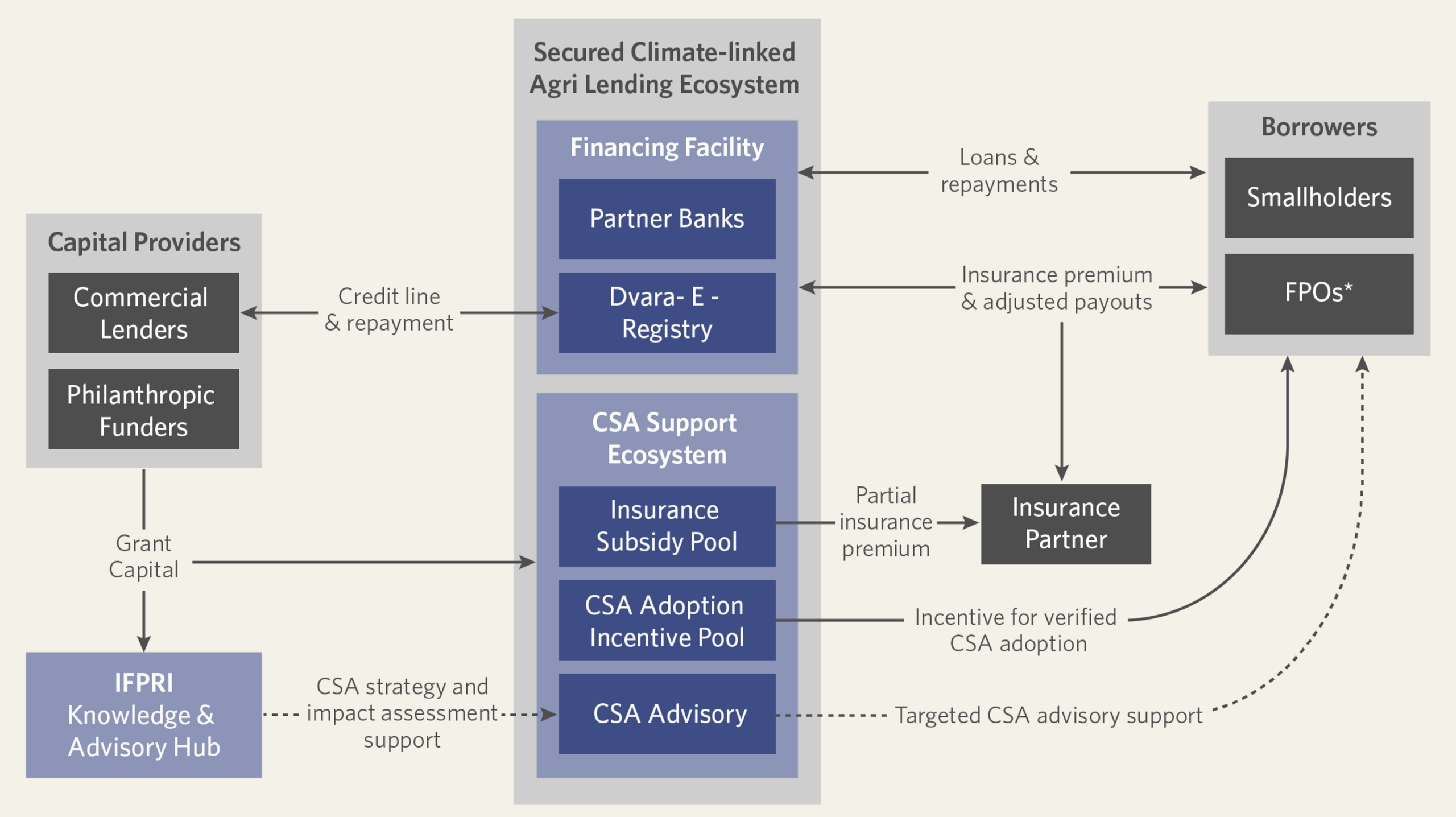
*Farmer Producer Organizations are collectives that improve access to markets, finance, and services.
Pipeline
The vehicle will deploy capital through a phased approach, beginning with the pilot before scaling to additional farmers and geographies. Loans of approximately USD 700 per farmer will finance eligible CSA practices and inputs, including alternate wetting and drying, direct-seeded rice, drip irrigation, bio-inputs, and stress-tolerant crop varieties.
The pilot will leverage Dvara E-Registry’s existing farmer networks and lending partnerships with MFI, banks, and other NBFCs. Following the impact validation on repayment, CSA adoption, insurance performance, and technology accuracy, deployment will expand to additional geographies.
Dvara E-Registry is expected to initiate lending through its own books once the NBFC license is secured, allowing for increased control over lending terms and use of proceeds for CSA adoption against differential interest rate offerings.