Overview
Latin American Climate Resilience Coffee Facility (LATTE) developed by IDH Investment is a USD 30M senior debt (~70%) and junior first-loss (~30%) vehicle deploying junior debt and guarantees to scale resiliency financing for smallholder coffee farmers across Colombia.
Innovation
Up to 88% of coffee-growing areas in Latin America could become unsuitable by 2050 as rising temperatures and erratic rainfall reduce yields and push cultivation higher, threatening millions of smallholder families. Climate finance flows to smallholder agrifood systems remain far below what is needed, making up less than 1% of global climate finance. In Colombia alone, approximately 563,000 Arabica smallholders require this support, but high upfront costs and the absence of land titles or credit histories make adaptation finance a particular challenge for conventional lenders. This represents a ~USD 914M financing opportunity across target smallholder farms and high-priority adaptation practices, within a broader ~USD 2.5B resilience financing opportunity across all farms and practices.
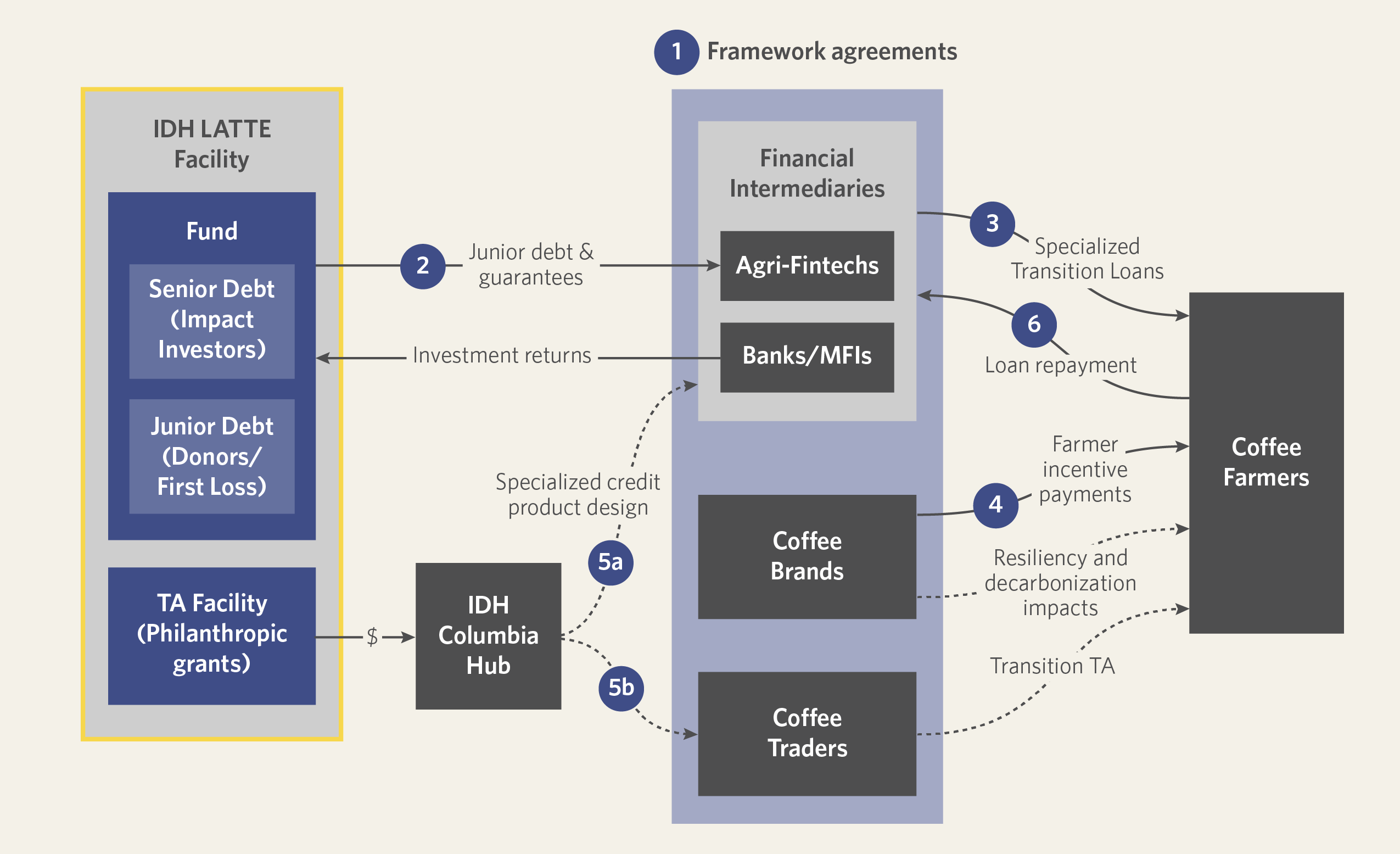
LATTE addresses this through a systemic approach that coordinates capital, farmer incentives, and technical assistance across the value chain, aligning coffee brands, traders, and financial intermediaries around a shared, replicable model. It leverages IDH’s positioning in the coffee sector, de-risking capital for local financial intermediaries so they can extend affordably priced credit to smallholders, while brand-funded incentive payments strengthen farmer cash flow.
Impact
LATTE aims to build a climate-resilient, low-carbon, and financially inclusive coffee sector in Latin America, delivering resilient farmer livelihoods and a secure, loweremission coffee supply. Over a five-year deployment, LATTE projects reaching 16,000 farmers with financing and technical assistance, bringing 22,400 hectares under climate-smart agriculture practices, deploying USD 28M in loan capital, avoiding or sequestering 187,000 tCO2e, and improving average yields by 17% versus baseline.
These outcomes are expected to build a track record of improved farmer lending performance, encouraging corporates to sustain and expand incentive payments while helping establish coffee lending as a viable asset class.
“The Lab’s climate finance and blended finance expertise will help refine LATTE’s capital structure, including modelling the investment and setting tranches within one facility.”
Evgenia Sokolova, Program Director, IDH Invest.
Investment Strategy
LATTE pre-designs specialized transition loans for financial intermediaries, including agri-fintechs, MFIs, and banks, to extend to smallholder coffee farmers, backed by LATTE’s de-risking capital. LATTE provides junior/subordinated debt and guarantees: envisioned junior debt amounts are USD 1-5M, and guarantees will make up less than 35% of the total loan book with an 8% annual fee. Financial intermediaries are selected based on geographic overlap with target brand supply sheds. The specialized transition loans finance short-term interventions such as low-carbon fertilizer and shade crop integration, medium-term interventions such as biochar, and long-term interventions such as agroforestry and farm renovation with resistant varieties.
Pipeline
More than 10 financial intermediaries have been identified and screened across Colombia’s rural lending base, sourced through IDH’s reVive Hub; six were interviewed in depth, with one already in an active pilot. Together, the interviewed intermediaries manage on the order of USD 40M+ in agricultural lending today. An illustrative LATTE pipeline of approximately USD 12M to 20M is already in active conversation or in pilot phase, reaching roughly 5,000 to 9,000 coffee farmers. Examples include Confiamos (MFI, Nariño, active pilot), Agricapital (Fintech, national, advanced conversations), and Crezcamos (MFI, multi-region, preliminary conversations).