Overview
Brazil Resilience through Climate Credit and Insurance for SMEs (BRACCE), developed by Stone and Zurich, is a credit enhancement vehicle that bundles SME credit with embedded flood and heavy-rainfall business interruption insurance. It will launch as a USD 20M demonstration fund, with the potential to scale to USD 100M+ as the model proves itself.
Innovation
Climate-vulnerable urban SMEs in Brazil face limited access to affordable credit and insufficient protection against climate-related losses, especially floods and heavy rainfall. Traditional lending and underwriting systems fail to account for climate hazards, leaving lenders and SMEs unprotected against business interruptions. SMEs rarely buy climate insurance on their own, and post-disaster financial recovery is slow and fragmented.
BRACCE solves these challenges with a unique, integrated credit-insurance model for urban SMEs, combining a primary parametric trigger (under evaluation by Zurich) with indemnity recourse. Instead of relying on individual SMEs to purchase insurance voluntarily, BRACCE embeds insurance directly into the credit structure at the fund level, eliminating affordability burdens.
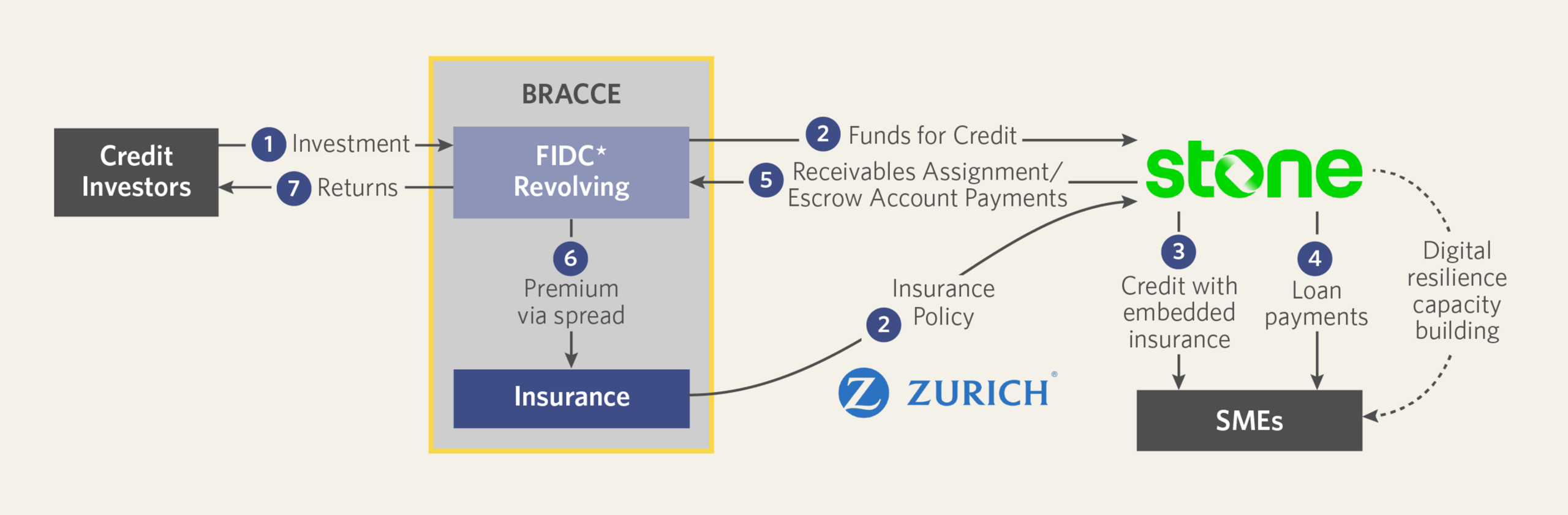
It integrates Stone’s payment terminal data and credit history with Zurich’s insurance capabilities and AdaptaBrasil municipal-level flood risk data to screen and price flood and heavy-rainfall risk at onboarding. When a covered event occurs, Zurich pays Stone directly under the policy, and Stone forgives the loan installments due during the interruption, capped at three installments per event, turning unhedged climate shocks into a shared, underwritten risk.
Impact
At the USD 20M demonstration phase, BRACCE models financing ~4,120 SMEs and supporting ~8,240 formal jobs, roughly 206 SMEs and 412 jobs per USD 1M invested. Scaling to USD 100M+ expands reach to ~20,600 SMEs and ~41,200 jobs, all with embedded flood cover.
The implementation pathway progressively moves from a demonstration supported by concessional capital toward a fully commercial model. Each USD 1 of impact mezzanine capital mobilizes 2.3x in commercial and first-loss capital during the demonstration phase, with USD 6M unlocking USD 14M. At scale, this increases to 4x, with USD 20M unlocking USD 80M. The concessional layer can then step away entirely, demonstrating the potential for embedded climate insurance to strengthen SME resilience at scale.
“The opportunity to conduct a robust modeling test and, thanks to the Lab’s powerful network, to understand potential market interest and assess the possibility of scaling this product.
Carolina da Costa, Chief Impact Officer, Stone
Design
BRACCE is structured under Brazilian law as a receivables fund (Fundo de Investimento em Direitos Creditórios – FIDC). Capital from credit investors is deployed to SMEs in the form of loans originated through Stone’s existing client and payment-terminal channels, with the resulting receivables assigned to the fund. Part of the credit spread earned on the loan payments is automatically directed to pay Zurich insurance premiums, embedding business interruption and climate insurance coverage directly into the credit product.
The investment strategy executes across three phases (Demonstration, Scaling, and Commercial), scaling total fund capacity from USD 20M to USD 100M+. Lead partner Stone Co. provides a 10% first-loss equity position across all phases to de-risk senior/mezzanine investors. In comparison, the concessional share falls from 30% to 20%, then to zero as commercial investor participation grows. Base-case demonstration-phase IRRs are 18.2% (Senior), 16.5% (Mezzanine) and 14.7% (Junior). Educational support is delivered to SMEs via an app.
Pipeline
BRACCE originates from Stone’s existing SME base of 4.7M clients and a USD 560M credit portfolio, with USD 24M (4.3%) exposed to very high vulnerability to floods and heavy rainfall. The demonstration phase draws on that book, blended with medium-vulnerability areas, to keep the pool insurable, and scaling applies the same mix across Stone’s national footprint.
Eligibility is screened against Stone’s E&S procedures, DFI exclusion lists, and municipal-level flood risk before onboarding. Around 75% of active credit clients are in Retail Trade and Food & Beverage, whose shared profile of fixed premises, daily cash flow, and local customers allows flood loss to be priced once rather than on a borrower-by-borrower basis. Capital revolves every six months, in alignment with underlying asset tenors.